
Facial Reconstruction After Mohs Surgery
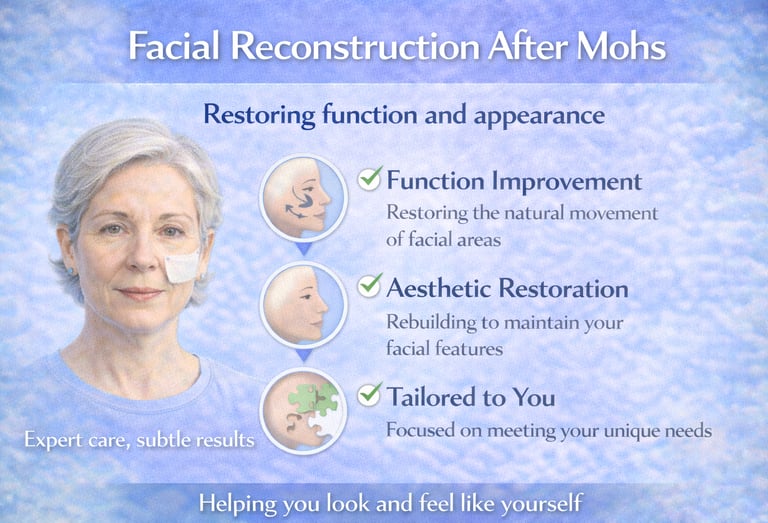
Facial reconstruction after Mohs surgery focuses on restoring both appearance and function following skin cancer removal. This page explains why reconstruction may be needed, when it is performed, and the approaches commonly used to support healing and natural results.
Understanding Facial Reconstruction After Mohs Surgery
Facial reconstruction is sometimes needed after Mohs surgery to help restore the appearance and function of the treated area. Because Mohs surgery removes only tissue affected by skin cancer, the resulting wound is often smaller than with other surgical methods. Even so, reconstruction may be recommended when the cancer is located on the face or in an area where healing requires additional support.
Reconstruction is planned carefully and performed with attention to both medical and aesthetic considerations. The approach depends on the size, depth, and location of the surgical site, as well as each patient’s overall health. The goal is to support proper healing while maintaining natural facial structure and movement.
Why Reconstruction May Be Needed
Reconstruction may be recommended when the surgical site is too large or deep to heal well on its own. This is more common when skin cancer affects areas such as the nose, eyelids, lips, or ears. The need for reconstruction is based on medical considerations, not cosmetic preference.
Factors that may influence the need for reconstruction include:
The size and depth of the wound
The location of the skin cancer on the face
The surrounding skin’s ability to heal naturally
Goals of Facial Reconstruction
The primary goals of facial reconstruction are to support proper healing and preserve normal facial function. Surgeons also aim to achieve a natural appearance that blends with surrounding skin whenever possible.
Key goals of reconstruction include:
Protecting important facial structures
Restoring skin coverage and strength
Maintaining movement and expression
Supporting long-term healing and skin health
Each reconstruction plan is individualized based on established surgical principles and the specific needs of the surgical site.
When Facial Reconstruction Is Performed
The timing of facial reconstruction after Mohs surgery depends on several medical and surgical factors. In many cases, reconstruction is planned in advance and completed shortly after the skin cancer has been fully removed. Your care team considers safety, healing, and the specific characteristics of the surgical site when determining the appropriate timing.
Same-Day Reconstruction After Cancer Removal
Facial reconstruction is often performed on the same day as Mohs surgery. Once the Mohs surgeon confirms that all cancer cells have been removed, reconstruction can begin immediately. This approach allows the wound to be repaired before significant swelling occurs and helps streamline the overall treatment process.
Same-day reconstruction may:
Reduce the need for additional procedures
Support more predictable healing
Allow patients to begin recovery sooner
Factors That Influence Timing
In some situations, reconstruction may be delayed to allow swelling to decrease or to address other medical considerations. The timing is based on careful evaluation, not urgency alone.
Factors that may influence when reconstruction is performed include:
Size and depth of the surgical wound
Location on the face and nearby structures
Patient health and healing considerations
Complexity of the reconstruction technique
Your surgeon will explain the recommended timing and what to expect as part of the overall care plan, ensuring that reconstruction is performed in a safe and appropriate manner.
Facial Areas Commonly Reconstructed
Skin cancers treated with Mohs surgery often occur on areas of the face that receive significant sun exposure. Because these areas are highly visible and involved in everyday functions, reconstruction is sometimes needed to support healing and maintain normal appearance and movement. The reconstruction approach varies based on the location and size of the surgical site.
Nose
The nose is one of the most common locations for skin cancer and Mohs surgery. Its shape, limited excess skin, and central position on the face can make reconstruction more complex. Techniques are selected to preserve nasal structure and airflow while blending the repair with surrounding skin.
Eyelids
Reconstruction of the eyelids requires careful attention to protect the eye and maintain normal blinking. Even small surgical sites in this area may need reconstruction to prevent irritation or exposure of the eye. The goal is to support eye comfort, vision, and proper eyelid function during healing.
Lips
The lips play an important role in speaking, eating, and facial expression. When reconstruction is needed in this area, preserving movement and sensation is a priority. Surgical techniques are chosen to maintain lip shape and function while allowing the area to heal appropriately.
Ears
Skin cancers on the ears are common due to sun exposure and can involve cartilage beneath the skin. Reconstruction may be needed to restore contour and protect the ear’s structure. The approach depends on the size of the wound and the portion of the ear affected.
Cheeks & Forehead
The cheeks and forehead typically have more available skin, which can allow for a variety of reconstruction options. Even so, careful planning is important to minimize visible scarring and maintain natural facial contours. The goal is a repair that heals smoothly and blends with surrounding facial features.
Facial Reconstruction Techniques
Several surgical techniques may be used to repair the skin after Mohs surgery on the face. The choice of technique depends on the size, depth, and location of the surgical site, as well as how the surrounding skin can be safely repositioned. All reconstruction methods are selected with healing, function, and long-term skin health in mind.
Primary Closure
Primary closure involves carefully bringing the edges of the wound together and closing it with sutures. This technique is often used for smaller surgical sites where the surrounding skin has enough flexibility. When appropriate, primary closure can support straightforward healing and minimize visible scarring.
Skin Flaps
Skin flaps use nearby healthy skin to cover the surgical site. The skin remains connected to its original blood supply and is repositioned to close the wound. This technique is commonly used on the face because it allows the repair to better match surrounding skin in color and texture.
Skin Grafts
Skin grafts involve taking a thin piece of skin from another area of the body and placing it over the surgical site. Grafts are used when nearby skin cannot be safely moved to close the wound. Healing requires careful monitoring to ensure the graft establishes proper blood supply.
Staged Reconstruction
Staged reconstruction is performed in planned steps over time rather than in a single procedure. This approach may be used for larger or more complex surgical sites that require gradual healing or refinement. Each stage is timed to support safe recovery and optimal long-term results.
Who Performs Facial Reconstruction
Facial reconstruction after Mohs surgery is performed by surgeons with specialized training in skin cancer treatment and reconstructive techniques. The goal is to ensure that reconstruction is done safely, with careful attention to both healing and facial function. Who performs the reconstruction depends on the complexity of the surgical site and the structures involved.
Mohs Surgeon–Performed Reconstruction
Many Mohs surgeons are trained to perform facial reconstruction themselves. When the surgical site is appropriate, the Mohs surgeon may complete the reconstruction immediately after confirming that all cancer cells have been removed. This allows for continuity of care and coordination between cancer removal and repair.
Mohs surgeon–performed reconstruction is often used for:
Small to moderate surgical sites
Areas where local tissue can be safely repositioned
Straightforward closures or flap repairs
Collaboration with Facial Plastic or Oculoplastic Surgeons
For more complex cases, reconstruction may involve collaboration with a facial plastic surgeon or oculoplastic surgeon. This is more common when the surgical site affects delicate structures such as the eyelids, nose, or lips, or when deeper layers are involved.
Working with a specialized reconstructive surgeon helps ensure:
Protection of critical facial structures
Preservation of function, such as vision or speech
Careful planning for more complex repairs
Your care team will explain who will be involved in reconstruction and why that approach is recommended for your specific surgical needs.
Functional & Cosmetic Considerations
Facial reconstruction after Mohs surgery is planned with both function and appearance in mind. The face plays a vital role in expression, communication, and daily activities, so reconstruction must support healing without disrupting these functions. Surgical decisions are guided by established reconstructive principles and the specific needs of each facial area.
Preserving Facial Movement & Expression
Maintaining normal facial movement is a key priority during reconstruction. This includes protecting muscles and nerves involved in blinking, smiling, speaking, and other expressions. Reconstruction techniques are chosen to allow the face to move naturally as healing progresses.
Careful attention is given to:
Muscle alignment and tension
Nerve protection when possible
Placement of incisions to support normal movement
Maintaining Natural Facial Contours
Reconstruction also aims to preserve the natural shape and symmetry of the face. Techniques are selected to blend the repair with surrounding skin and maintain normal contours. While some scarring is expected after any surgery, careful planning helps scars heal in less noticeable areas whenever possible.
Over time, continued healing and follow-up care support improved appearance and skin strength as the surgical site matures.
What to Expect During Recovery
Recovery after facial reconstruction varies depending on the size and location of the surgical site and the type of reconstruction performed. Most patients experience a gradual healing process that continues over several weeks to months. Your care team will provide clear instructions to support healing and help you understand what is normal during recovery.
Early Healing Expectations
In the first days after reconstruction, the focus is on protecting the surgical site and allowing the skin to heal properly. Stitches may be present, and a bandage is often used to keep the area clean. Activity restrictions are common early on to reduce tension on the wound and support healing.
Many patients find it helpful to review detailed guidance on wound care and recovery steps on the Aftercare & Recovery After Mohs Surgery page and the Healing Timeline After Mohs Surgery page.
Swelling, Bruising & Appearance Changes
Swelling and bruising are common after facial reconstruction, especially in the first one to two weeks. The treated area may appear red, firm, or uneven as the skin heals. These changes typically improve gradually over time as swelling decreases and the tissue settles.
Temporary changes in appearance are expected during healing. Your surgeon will explain what to watch for, when improvements typically occur, and when to contact the office with concerns. Additional information about what to expect as healing progresses can be found on the Aftercare & Recovery and Healing Timeline pages.
Scarring After Facial Reconstruction
Some degree of scarring is a normal and expected part of any surgical procedure, including facial reconstruction after Mohs surgery. The appearance of scars varies based on individual healing, the location of the surgical site, and the reconstruction technique used. Careful planning and proper aftercare play an important role in how scars heal over time.
How Scars Mature Over Time
Scars change gradually as the body heals. In the early stages, scars may appear red, raised, or firm. Over the following months, they often soften, flatten, and fade in color as the healing process continues.
Scar maturation typically occurs over several months to a year. During this time, ongoing follow-up allows your care team to monitor healing and address concerns as the skin continues to strengthen and remodel.
Techniques to Minimize Visible Scarring
Reconstructive techniques are selected with scar appearance in mind, especially on the face. Surgeons place incisions along natural skin lines or contours when possible to help scars blend in more naturally.
Additional factors that support scar healing include:
Proper wound care and sun protection
Following activity and care instructions during recovery
Regular follow-up appointments to monitor healing
Your surgeon will discuss realistic expectations for scarring and provide guidance on supporting healthy scar maturation.
Frequently Asked Questions About Facial Reconstruction After Mohs
Patients often have questions about facial reconstruction following Mohs surgery. Understanding the process and what to expect can help reduce uncertainty and support informed decision-making. Below are answers to some common questions patients ask.
Common Patient Questions
Will I need facial reconstruction after Mohs surgery?
Not everyone requires reconstruction. The need depends on the size, depth, and location of the surgical site, as well as how the area is expected to heal on its own.
Is facial reconstruction considered cosmetic surgery?
Facial reconstruction after Mohs surgery is a medically necessary procedure focused on repair and healing. While appearance is considered, the primary goals are function, protection of facial structures, and proper wound closure.
Will reconstruction be done the same day as Mohs surgery?
In many cases, reconstruction is performed on the same day once all cancer cells have been removed. Timing depends on medical factors and the complexity of the repair.
Will facial reconstruction leave a scar?
Some scarring is expected with any surgery. Over time, scars typically soften and become less noticeable as healing progresses. Your surgeon will discuss realistic expectations and scar care as part of recovery.
How long does recovery take after facial reconstruction?
Initial healing usually occurs within a few weeks, but full healing and scar maturation can take several months. Recovery time varies based on the reconstruction technique and individual healing.
If you have additional questions, your care team can provide personalized information based on your diagnosis and treatment plan.


Request a Mohs Consultation
Copyright © 2026 | Savannah Mohs Surgery | All Rights Reserved.
Privacy Policy | Terms and Conditions | Accessibility
Monday: 8:00am - 5:00pm
Tuesday: 8:00am - 5:00pm
Wednesday: 8:00am - 5:00pm
Thursday: 8:00am - 5:00pm
Friday: 8:00am - 5:00pm
Office Hours
Learn More
Reach Out
Resources
Address
Request Consultation
Call Now
(704) 858-6585
Savannah Mohs Surgery
Serving Savannah, GA and Surrounding areas.

