
Skin Cancer Removal with Mohs Surgery
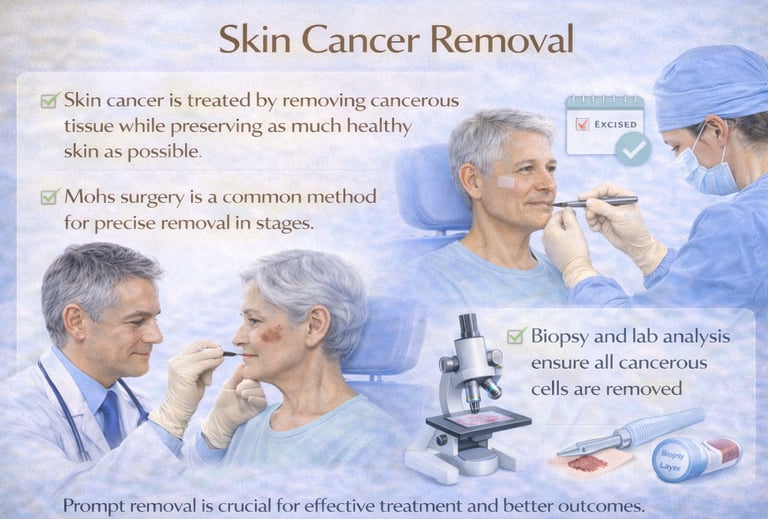
Skin cancer removal focuses on completely eliminating cancerous cells while preserving as much healthy tissue as possible. This page explains how skin cancer is removed, the goals of treatment, and when Mohs surgery may be recommended for precise cancer removal.
Mohs surgery is a specialized form of skin cancer removal that focuses on precision, tissue preservation, and careful evaluation of cancer cells. It is commonly used to treat certain types of skin cancer, especially in areas where preserving healthy skin is important. For many patients, Mohs surgery offers a thorough and methodical approach to removing skin cancer while minimizing damage to surrounding tissue.
This procedure is performed by a specially trained Mohs surgeon who examines the removed tissue during the surgery itself. By checking the edges of each layer under a microscope, the surgeon can confirm that cancer cells have been removed before the procedure is complete. The sections below explain how Mohs surgery works, when it is recommended, and what patients can expect throughout the treatment process.
Understanding Skin Cancer Removal
Skin cancer removal refers to the medical process of eliminating cancerous cells from the skin while protecting as much healthy tissue as possible. The method used depends on the type, size, location, and behavior of the skin cancer, as well as a patient’s overall health. Mohs surgery is one approach that allows for careful, step-by-step removal and immediate examination of the affected tissue.
What Skin Cancer Removal Means
When skin cancer is diagnosed, removal is necessary to prevent the cancer from growing deeper, spreading to nearby tissue, or recurring. Skin cancer removal is not a cosmetic procedure; it is a medically necessary treatment focused on eliminating cancer cells. The goal is to treat the cancer effectively while supporting proper healing and skin function.
Different techniques may be used for skin cancer removal, including surgical excision, topical treatments, or dermatologic surgery such as Mohs. Your dermatologist recommends a specific method based on established medical guidelines and the characteristics of the cancer.
Goals of Cancer Removal with Mohs Surgery
Mohs surgery is designed to remove skin cancer in the most precise way possible. The primary goals of this technique include:
Completely removing cancer cells while sparing healthy skin
Reducing the risk of cancer recurrence
Preserving appearance and function, especially in visible or sensitive areas
Providing immediate confirmation that cancer margins are clear
This focused approach makes Mohs surgery an important option for treating certain skin cancers, including basal cell carcinoma and squamous cell carcinoma, particularly when accuracy and tissue conservation are priorities.
How Mohs Surgery Removes Skin Cancer
Mohs surgery is a precise form of skin cancer removal designed to treat cancer while preserving as much healthy skin as possible. The procedure is performed in carefully controlled stages, allowing the surgeon to remove cancer cells with a high level of accuracy.
Layer-by-Layer Cancer Removal
During Mohs surgery, the visible skin cancer is removed along with a very thin layer of surrounding tissue. Instead of removing a large area all at once, the surgeon removes tissue in stages, or layers. Each layer is processed and examined before deciding whether additional tissue needs to be removed.
This approach helps minimize the removal of healthy skin while targeting cancer cells that may not be visible on the surface.
Real-Time Microscopic Examination
After each layer is removed, the tissue is prepared and examined under a microscope by the Mohs surgeon. This allows the surgeon to check the entire outer and deep edges of the tissue for cancer cells.
Because the examination happens during the procedure, results are available right away. If cancer cells are still present, their exact location is identified, guiding where the next layer should be removed.
Ensuring Clear Margins
The process of removing and examining tissue continues until no cancer cells are seen at the edges, also called “clear margins.” Clear margins indicate that the skin cancer has been fully removed.
This method allows Mohs surgery to achieve high cure rates while reducing the chance of cancer recurrence. It also helps preserve healthy tissue, which is especially important in areas such as the face, ears, hands, and nose.
Types of Skin Cancer Removed with Mohs Surgery
Mohs surgery is commonly used to treat certain types of skin cancer, especially when precision and tissue preservation are important. It is often recommended for cancers in visible or sensitive areas, as well as for tumors with a higher risk of recurrence.
Basal Cell Carcinoma
Basal cell carcinoma is the most common type of skin cancer. It often develops in areas with long-term sun exposure, such as the face, scalp, ears, and neck.
Mohs surgery is frequently used for basal cell carcinoma because it allows the Mohs surgeon to remove the cancer while sparing healthy surrounding skin. This is particularly important for tumors with poorly defined edges or those located in cosmetically sensitive areas.
Squamous Cell Carcinoma
Squamous cell carcinoma is the second most common type of skin cancer and can be more aggressive than basal cell carcinoma. It may grow deeper into the skin and has a higher risk of spreading if not treated promptly.
Mohs surgery is often recommended for squamous cell carcinoma that is located on the face, hands, feet, or genitals, or for tumors that are large, fast-growing, or recurrent. The precise nature of Mohs surgery helps ensure complete cancer removal.
High-Risk or Recurrent Skin Cancers
Mohs surgery is also used for skin cancers considered high risk or those that have returned after previous treatment. These cancers may have irregular growth patterns or extend beyond what is visible on the skin.
By examining tissue margins during the procedure, Mohs surgery provides an effective approach for treating complex or recurrent skin cancers while minimizing the removal of healthy tissue.
Why Mohs Surgery Is Highly Effective for Cancer Removal
Mohs surgery is widely recognized as one of the most effective treatments for certain types of skin cancer. Its success comes from a combination of precision, careful tissue analysis, and a methodical approach to cancer removal.
Precision & Tissue Preservation
Mohs surgery removes skin cancer in thin, targeted layers rather than taking a wide area of tissue at once. This level of precision allows the Mohs surgeon to focus only on areas where cancer cells are present.
By preserving as much healthy skin as possible, Mohs surgery is especially well suited for areas where appearance and function are important, such as the face, ears, eyelids, hands, and nose.
Highest Cure Rates for Skin Cancer
Because Mohs surgery examines 100 percent of the surgical margins under a microscope, it offers some of the highest cure rates for basal cell carcinoma and squamous cell carcinoma. This comprehensive evaluation helps ensure that cancer cells are fully identified and removed.
High cure rates are achieved without relying on large surgical margins, which helps balance effectiveness with tissue conservation.
Reduced Risk of Recurrence
The step-by-step process used in Mohs surgery reduces the likelihood that cancer cells will be left behind. By identifying and removing cancer at its exact location, the procedure lowers the risk of the skin cancer returning in the same area.
For patients with recurrent or high-risk skin cancers, Mohs surgery provides an added level of confidence through thorough margin control and careful long-term management.
Cancer Removal in Sensitive or High-Risk Areas
Mohs surgery is often recommended for skin cancers located in areas where preserving healthy tissue is especially important. These regions may be cosmetically sensitive, functionally critical, or both, making precision essential during skin cancer removal.
Face, Nose, Ears, Lips & Eyelids
Skin cancers on the face and nearby structures require careful treatment to protect both appearance and function. The nose, ears, lips, and eyelids have complex anatomy and limited excess skin, which can make reconstruction more challenging.
Mohs surgery allows the Mohs surgeon to remove cancer cells with accuracy while conserving as much healthy tissue as possible. This approach helps support optimal healing and appearance following dermatologic surgery.
Hands, Feet & Other Functionally Important Areas
The hands and feet play a critical role in daily activities and contain structures such as tendons, nerves, and joints that must be protected. Skin cancers in these areas may also spread in less predictable patterns.
Mohs surgery provides detailed margin control, helping ensure complete cancer removal while minimizing damage to surrounding tissue. This precision helps preserve movement, sensation, and function during skin cancer treatment.
What Happens After the Cancer Is Removed
Once all cancer cells have been removed, the focus of Mohs surgery shifts to confirming the results and planning the next phase of care. This step is an important part of ensuring both effective treatment and proper healing.
Confirmation of Complete Cancer Removal
The Mohs surgeon confirms that all surgical margins are clear, meaning no cancer cells are seen at the edges of the removed tissue. This confirmation is based on the microscopic examination performed during the procedure.
Clear margins indicate that the skin cancer has been fully removed at the time of surgery. This careful verification helps reduce the risk of the cancer returning in the treated area.
Next Steps: Repair & Reconstruction
After cancer removal is complete, the surgical site is addressed to support healing and function. Depending on the size and location of the area, the wound may be allowed to heal naturally or be repaired using stitches, a skin flap, or a skin graft.
In many cases, repair is performed the same day as Mohs surgery. The approach is selected with attention to both medical healing and cosmetic outcome, while prioritizing patient safety and long-term skin health.
Safety & Accuracy of Mohs Cancer Removal
Mohs surgery is considered a safe and highly accurate approach to skin cancer removal when performed by properly trained specialists. The procedure combines surgical expertise with immediate microscopic analysis to support effective and carefully controlled treatment.
Fellowship-Trained Mohs Surgeons
Mohs surgery is performed by dermatologists who have completed advanced fellowship training in Mohs micrographic surgery and dermatologic oncology. This specialized training includes extensive experience in skin cancer removal, pathology interpretation, and surgical reconstruction.
A fellowship-trained Mohs surgeon is uniquely qualified to both remove the cancer and examine the tissue under a microscope. This dual role helps ensure accuracy at every stage of the procedure.
In-Office Pathology & Same-Day Results
One of the key safety features of Mohs surgery is the ability to analyze tissue on-site during the procedure. Each layer of removed skin is processed and examined in an in-office laboratory, allowing for immediate evaluation.
Because results are available the same day, decisions about additional tissue removal are made in real time. This reduces uncertainty, limits unnecessary tissue removal, and allows patients to leave the office knowing their cancer has been addressed.
Frequently Asked Questions About Cancer Removal with Mohs Surgery
Common Patient Questions
Does Mohs surgery remove all of the skin cancer?
Mohs surgery is designed to remove skin cancer completely by examining the full edges of the removed tissue during the procedure. The surgeon continues removing layers until no cancer cells are seen. While no medical treatment can guarantee outcomes, this method provides a high level of accuracy.
How long does Mohs surgery take?
The length of the procedure varies depending on the size and depth of the skin cancer. Most patients should plan to spend several hours in the office, as there may be waiting periods while tissue is examined under the microscope.
Is Mohs surgery painful?
Mohs surgery is performed using local anesthesia, which numbs the treatment area. Patients typically remain comfortable during the procedure, with minimal discomfort afterward that can usually be managed with simple pain relief measures.
Will I have a scar after Mohs surgery?
Any surgical procedure can result in a scar. Mohs surgery is designed to preserve as much healthy skin as possible, which can help limit scarring. The size and appearance of a scar depend on the location and extent of the cancer and how the area heals.
What happens if cancer cells are found during surgery?
If cancer cells are detected in the examined tissue, the Mohs surgeon removes another thin layer from the specific area where cancer remains. This process continues until the margins are clear.
Is Mohs surgery done in one visit?
Yes, Mohs surgery is typically completed in a single visit. Cancer removal, confirmation of clear margins, and wound repair are often performed on the same day.
Request a Mohs Consultation


Copyright © 2026 | Savannah Mohs Surgery | All Rights Reserved.
Privacy Policy | Terms and Conditions | Accessibility
Monday: 8:00am - 5:00pm
Tuesday: 8:00am - 5:00pm
Wednesday: 8:00am - 5:00pm
Thursday: 8:00am - 5:00pm
Friday: 8:00am - 5:00pm
Office Hours
Learn More
Reach Out
Resources
Address
Request Consultation
Call Now
(704) 858-6585
Savannah Mohs Surgery
Serving Savannah, GA and Surrounding areas.

