
Is Mohs Surgery
Right for Me?
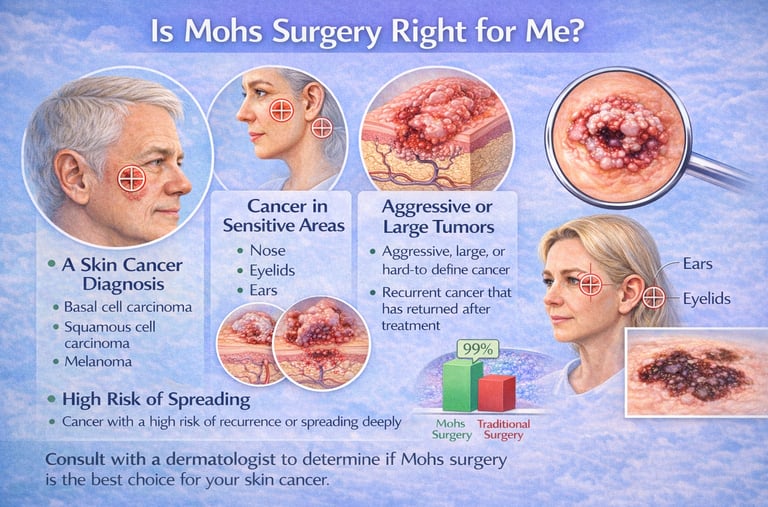
Mohs surgery is not needed for every type of skin cancer. This page explains when Mohs surgery is commonly recommended, which factors are considered when determining candidacy, and how dermatologists decide whether Mohs surgery is the most appropriate treatment option.
Being diagnosed with skin cancer often leads to questions about treatment options and what approach is best. Mohs surgery is one of several methods used to remove skin cancer, and it may be recommended in certain situations based on medical factors rather than patient preference alone.
Understanding when Mohs surgery is used—and how it compares to other treatments—can help patients feel more informed and confident as they discuss care options with their dermatologist or Mohs surgeon.
How Mohs Surgery Is Recommended
Mohs surgery is recommended based on specific medical criteria rather than as a routine treatment for all skin cancers. Dermatologists consider multiple factors to determine whether this approach is the most appropriate option.
How Dermatologists Decide on Mohs Surgery
Dermatologists evaluate the type of skin cancer, its location, size, and growth pattern when considering Mohs surgery. Cancers in areas where preserving healthy tissue is especially important, such as the face or hands, are more likely to be treated with this method.
A patient’s medical history and any prior skin cancer treatments are also taken into account during the decision-making process.
Role of Biopsy Results
Biopsy results provide essential information about the type and characteristics of the skin cancer. The biopsy identifies whether the cancer is basal cell carcinoma, squamous cell carcinoma, or another type, and may show features that indicate higher risk.
These findings help guide treatment recommendations and determine whether Mohs surgery offers advantages over other skin cancer removal methods.
Who Is a Good Candidate for Mohs Surgery
Mohs surgery is not necessary for every skin cancer, but it is often recommended in situations where precision and thorough cancer removal are especially important. Certain characteristics make Mohs surgery a preferred option.
Skin Cancers in High-Risk Areas
Skin cancers located on the face, nose, ears, lips, eyelids, hands, and other sensitive areas are often treated with Mohs surgery. These areas have limited extra skin and play important roles in appearance and function.
Mohs surgery allows careful removal of cancer while preserving as much healthy tissue as possible.
Aggressive or Recurrent Skin Cancers
Some skin cancers grow more aggressively or have a higher risk of returning after treatment. Cancers that have come back after previous treatment may also have irregular growth patterns beneath the skin.
Mohs surgery provides detailed margin control, making it well suited for treating these higher-risk cases.
Patients Needing Tissue Preservation
Patients who need to preserve healthy tissue due to cosmetic or functional concerns may benefit from Mohs surgery. This includes cancers near the eyes, mouth, or other areas where excess tissue removal could affect movement or appearance.
The precision of Mohs surgery helps balance effective cancer removal with tissue conservation.
When Mohs Surgery Is Often the Best Option
Mohs surgery is frequently recommended in situations where accuracy and complete cancer removal are essential. Certain tumor characteristics and locations make this approach especially effective.
Facial & Cosmetic Areas
Skin cancers on the face and other visible areas often require careful treatment to preserve appearance and function. Areas such as the nose, eyelids, lips, and ears have complex anatomy and limited extra skin.
Mohs surgery allows the surgeon to remove cancer while conserving as much healthy tissue as possible, supporting optimal healing in cosmetically sensitive areas.
Tumors with Ill-Defined Borders
Some skin cancers do not have clearly visible edges and may extend beyond what appears on the surface. These tumors can be more difficult to treat with standard excision alone.
Mohs surgery identifies and removes cancer cells at their exact location, making it well suited for tumors with irregular or poorly defined borders.
When Mohs Surgery May Not Be Necessary
Mohs surgery is a valuable treatment option, but it is not required for every skin cancer. In some cases, other treatments may be appropriate based on the cancer’s characteristics and overall risk.
Low-Risk or Small Tumors
Small, low-risk skin cancers located in areas where tissue preservation is less critical may not require Mohs surgery. These tumors often have well-defined borders and a lower likelihood of recurrence.
In such cases, simpler treatment approaches may be effective.
Alternative Treatment Options
Alternative treatments may include standard surgical excision, curettage and electrodesiccation, topical therapies, or radiation therapy. The choice depends on the type of skin cancer, its location, and patient-specific factors.
Your dermatologist reviews the benefits and limitations of each option to recommend the most appropriate treatment plan.
Factors That Influence Whether Mohs Is Right for You
The decision to recommend Mohs surgery is based on a combination of medical factors rather than any single consideration. Dermatologists evaluate each case carefully to determine the most appropriate treatment approach.
Age & Overall Health
A patient’s age and general health are considered when planning skin cancer treatment. Certain medical conditions or medications may influence healing and recovery, which can affect treatment selection.
The goal is to choose an option that balances effectiveness with safety and overall well-being.
Location, Size & Type of Skin Cancer
The location, size, and type of skin cancer play a major role in determining whether Mohs surgery is recommended. Cancers in high-risk or cosmetically sensitive areas and those with aggressive features are more likely to benefit from Mohs surgery.
Basal cell carcinoma and squamous cell carcinoma are the most common cancers treated with this approach.
Prior Skin Cancer History
A history of previous skin cancers can influence treatment decisions. Cancers that have recurred or patients with multiple prior skin cancers may require more precise treatment and closer monitoring.
This history helps guide both treatment recommendations and follow-up care.
Benefits of Choosing Mohs Surgery
When Mohs surgery is recommended, it offers several advantages that support effective skin cancer removal while prioritizing healthy tissue. These benefits are based on the unique structure of the procedure.
Highest Cure Rates
Mohs surgery examines the entire surgical margin under a microscope during the procedure. This thorough evaluation contributes to high cure rates for certain types of skin cancer, particularly basal cell carcinoma and squamous cell carcinoma.
High cure rates are achieved without removing more tissue than necessary.
Maximum Tissue Preservation
By removing skin cancer in thin, targeted layers, Mohs surgery helps preserve as much healthy skin as possible. This precision is especially important in areas where appearance and function are closely linked.
Tissue preservation can support better healing and reconstruction outcomes.
Same-Day Results
Mohs surgery provides real-time results because tissue is examined on-site during the procedure. Patients typically leave the office knowing whether the cancer has been fully removed.
This same-day confirmation reduces uncertainty and allows repair to be completed without delay.
Common Patient Concerns
It is normal to have questions or concerns when considering Mohs surgery. Understanding what to expect can help patients feel more comfortable and prepared.
Pain & Comfort
Mohs surgery is performed using local anesthesia, which numbs the treatment area. Most patients remain comfortable during the procedure and report only mild discomfort afterward.
Any post-procedure discomfort is typically manageable with simple pain relief measures recommended by the care team.
Recovery Time
Recovery time varies depending on the size and location of the surgical site and the type of repair performed. Many patients return to normal daily activities within a few days, with temporary restrictions on strenuous activity.
Healing continues over several weeks, with ongoing improvement over time.
Cosmetic Outcome
Preserving appearance is an important consideration, especially for skin cancers on visible areas. Mohs surgery is designed to remove cancer while conserving healthy tissue, which can support favorable cosmetic outcomes.
Reconstruction is planned with attention to both healing and long-term appearance, while recognizing that some scarring is expected with any surgical procedure.
How to Know for Sure if Mohs Surgery Is Right for You
Determining whether Mohs surgery is the most appropriate treatment involves a personalized medical evaluation. A consultation provides the opportunity to review your diagnosis, discuss treatment options, and address any concerns.
Consultation with a Mohs Surgeon
During a consultation, a fellowship-trained Mohs surgeon reviews biopsy results, examines the skin cancer, and considers factors such as location, size, and prior treatment history. This evaluation helps determine whether Mohs surgery offers advantages over other treatment methods.
The consultation also allows time to discuss the procedure, recovery, and follow-up care in detail.
Questions to Ask at Your Appointment
Patients may find it helpful to ask questions such as:
Why is Mohs surgery being recommended for my skin cancer?
What other treatment options are available?
What should I expect during recovery and healing?
Asking questions helps patients make informed decisions and feel more confident about their care plan.
Frequently Asked Questions About Mohs Surgery Candidacy
Common Decision-Making Questions
Is Mohs surgery the best treatment for every skin cancer?
No. Mohs surgery is recommended for specific situations based on the type, location, and risk level of the skin cancer. Many skin cancers can be effectively treated with other methods.
Can I choose Mohs surgery even if it is not recommended?
Treatment recommendations are based on medical guidelines and individual factors. Your dermatologist or Mohs surgeon can explain why a particular treatment is advised and discuss alternatives when appropriate.
Does needing Mohs surgery mean my skin cancer is more serious?
Not necessarily. Mohs surgery is often chosen because of where the cancer is located or the need to preserve healthy tissue, not solely because of cancer severity.
How is the decision made between Mohs surgery and standard excision?
The decision is based on biopsy results, tumor characteristics, location, and prior treatment history. These factors help determine which approach offers the most benefit.
Will insurance cover Mohs surgery if it is recommended?
Mohs surgery is commonly covered by insurance when medically indicated. Coverage details vary, and the office staff can help address insurance-related questions.


Request a Mohs Consultation
Copyright © 2026 | Savannah Mohs Surgery | All Rights Reserved.
Privacy Policy | Terms and Conditions | Accessibility
Monday: 8:00am - 5:00pm
Tuesday: 8:00am - 5:00pm
Wednesday: 8:00am - 5:00pm
Thursday: 8:00am - 5:00pm
Friday: 8:00am - 5:00pm
Office Hours
Learn More
Reach Out
Resources
Address
Request Consultation
Call Now
(704) 858-6585
Savannah Mohs Surgery
Serving Savannah, GA and Surrounding areas.

