
Wound Repair & Reconstruction Options
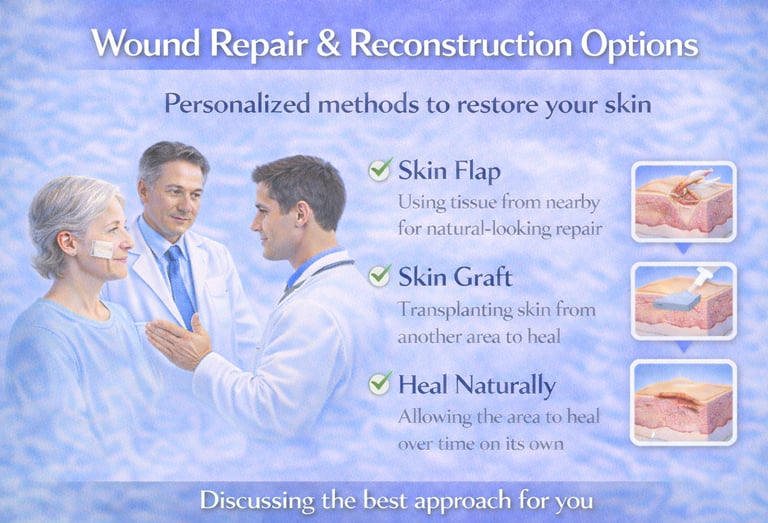
After skin cancer removal, wound repair and reconstruction are planned to support proper healing while preserving function and appearance. This page explains common wound repair and reconstruction options used after Mohs surgery and how treatment decisions are made.
After Mohs surgery confirms that all skin cancer has been removed, the focus shifts to healing the surgical site. Wound repair and reconstruction are important steps that support proper healing while aiming to preserve function and appearance.
Reconstruction after Mohs surgery is not one-size-fits-all. The approach is tailored to the size, depth, and location of the wound, as well as individual healing factors. This page explains the common wound repair and reconstruction options used after Mohs surgery, helping patients understand how healing is managed following skin cancer removal.
Understanding Wound Repair After Mohs Surgery
Once skin cancer removal is complete, attention turns to caring for the area where tissue was removed. Wound repair is an essential part of the Mohs surgery process and is planned with both healing and long-term outcomes in mind.
Why Wound Repair Is Necessary
Mohs surgery removes cancerous tissue layer by layer, which can leave a wound of varying size and depth. Proper wound repair helps protect the area, reduce the risk of infection, and support healthy healing. The repair approach depends on the location of the wound and how much tissue was removed.
Goals of Repair & Reconstruction
The goals of wound repair and reconstruction are to promote safe healing while preserving function and appearance. Key objectives include closing or managing the wound appropriately, supporting normal movement and sensation, and achieving a natural-looking result whenever possible. Each repair plan is tailored to the individual situation and performed using established dermatologic surgery techniques.
How Wound Repair Decisions Are Made
Wound repair after Mohs surgery is carefully planned based on medical and anatomical considerations. The Mohs surgeon evaluates several factors to determine the safest and most effective approach for healing and reconstruction.
Size, Depth & Location of the Wound
The size and depth of the wound play a major role in selecting a repair method. Wounds in highly visible or functionally important areas, such as the face or hands, often require more precise reconstruction. The location also influences how the skin moves and heals, which helps guide the repair technique.
Skin Type & Individual Healing Factors
Individual factors can affect how a wound heals. Skin thickness, elasticity, and overall health may influence repair decisions. The Mohs surgeon considers these elements to support proper healing and minimize complications, tailoring the reconstruction plan to each patient’s specific needs.
Primary Closure
Primary closure is one of the most common wound repair techniques used after Mohs surgery. It involves bringing the edges of the wound together and closing them with sutures.
When Primary Closure Is Used
Primary closure is typically used when the wound is small to moderate in size and the surrounding skin can be gently brought together without excessive tension. This approach is often appropriate when the wound is in an area with good skin flexibility and where direct closure will not distort nearby structures.
Benefits of Primary Closure
Primary closure allows the wound to heal in a controlled and efficient manner.
Benefits may include:
Shorter healing time
Predictable wound closure
A linear scar that often fades over time
This technique is commonly used when it can provide a safe and effective healing outcome.
Healing by Secondary Intention
Healing by secondary intention is a wound care approach in which the surgical site is allowed to heal naturally without stitches. The body gradually fills in the wound with new tissue over time.
Allowing the Wound to Heal Naturally
With this method, the wound is kept clean and protected while the body’s natural healing processes occur. New tissue forms from the base and edges of the wound, and the skin slowly closes on its own. Regular wound care and follow-up help support proper healing during this process.
When This Option Is Appropriate
Healing by secondary intention may be recommended for wounds that are small, shallow, or located in areas where natural healing can produce a good functional and cosmetic result. Certain locations, such as concave areas of the face, may heal well with this approach. The Mohs surgeon determines whether this option is appropriate based on the wound’s characteristics and individual healing factors.
Skin Flap Reconstruction
Skin flap reconstruction is a technique used to repair larger or more complex wounds after Mohs surgery. It involves repositioning nearby skin to cover the surgical site while maintaining its blood supply.
What a Skin Flap Is
A skin flap is created by gently moving adjacent skin into the wound area. Because the skin remains connected to its original blood supply, this method supports reliable healing. Skin flaps are often used in areas where direct closure is not possible without tension or distortion.
Common Flap Techniques
Several flap techniques may be used depending on the wound’s size and location.
Common types include:
Advancement flaps, which move skin directly forward
Rotation flaps, which rotate skin from a nearby area
Transposition flaps, which reposition skin from an adjacent site
The Mohs surgeon selects the flap technique that best supports healing, function, and appearance.
Skin Graft Reconstruction
Skin graft reconstruction is used when there is not enough nearby skin to close a wound after Mohs surgery. This technique involves transferring skin from another area of the body to cover the surgical site.
What a Skin Graft Is
A skin graft is a thin piece of skin taken from a donor site and placed over the wound. The graft relies on the wound bed to develop a new blood supply as it heals. Skin grafts may be used for larger wounds or in areas where skin movement is limited.
Donor Site Considerations
The donor site is chosen based on skin color, texture, and thickness to help achieve a natural-looking result. Common donor sites include areas that can be easily concealed. Both the donor site and the graft site require proper care during healing, and the Mohs surgeon provides guidance to support recovery at both locations.
Skin Graft Reconstruction
Skin graft reconstruction is used when there is not enough nearby skin to close a wound after Mohs surgery. This technique involves transferring skin from another area of the body to cover the surgical site.
What a Skin Graft Is
A skin graft is a thin piece of skin taken from a donor site and placed over the wound. The graft relies on the wound bed to develop a new blood supply as it heals. Skin grafts may be used for larger wounds or in areas where skin movement is limited.
Donor Site Considerations
The donor site is chosen based on skin color, texture, and thickness to help achieve a natural-looking result. Common donor sites include areas that can be easily concealed. Both the donor site and the graft site require proper care during healing, and the Mohs surgeon provides guidance to support recovery at both locations.
Staged Reconstruction
In some cases, wound repair after Mohs surgery is completed in more than one step. Staged reconstruction allows healing and planning to occur gradually, which can be beneficial for certain wounds or patient situations.
When Reconstruction Occurs in Multiple Steps
Staged reconstruction may be used when the wound is large, complex, or located in an area where immediate repair could compromise healing or function. In these situations, an initial repair or temporary closure may be performed, followed by additional reconstructive steps at a later time once the tissue has stabilized.
Reasons for Delayed Repair
Delaying reconstruction can be helpful when swelling needs to subside, blood supply must be optimized, or healing conditions need to improve before final repair. Staged approaches may also be chosen to achieve better cosmetic or functional outcomes. The decision is based on medical considerations and is tailored to the individual wound and patient.
Reconstruction in Sensitive Areas
Reconstruction after Mohs surgery requires special consideration when wounds are located in areas that affect appearance or daily function. In these cases, careful planning helps support both healing and long-term outcomes.
Facial & Cosmetic Areas
Wounds on the face, including the nose, eyelids, lips, and ears, require precise reconstruction due to the complex anatomy and visibility of these areas. Repair techniques are selected to preserve natural contours, maintain symmetry, and minimize noticeable scarring. Mohs surgeons are trained to balance effective healing with thoughtful cosmetic considerations.
Functionally Important Areas
Reconstruction is also carefully planned for wounds on areas such as the hands, fingers, feet, and joints. Preserving movement, sensation, and strength is a priority in these locations. Repair techniques are chosen to support normal function while protecting the surgical site during healing.
Reconstruction in Sensitive Areas
Reconstruction after Mohs surgery requires special consideration when wounds are located in areas that affect appearance or daily function. In these cases, careful planning helps support both healing and long-term outcomes.
Facial & Cosmetic Areas
Wounds on the face, including the nose, eyelids, lips, and ears, require precise reconstruction due to the complex anatomy and visibility of these areas. Repair techniques are selected to preserve natural contours, maintain symmetry, and minimize noticeable scarring. Mohs surgeons are trained to balance effective healing with thoughtful cosmetic considerations.
Functionally Important Areas
Reconstruction is also carefully planned for wounds on areas such as the hands, fingers, feet, and joints. Preserving movement, sensation, and strength is a priority in these locations. Repair techniques are chosen to support normal function while protecting the surgical site during healing.
Reconstruction in Sensitive Areas
Reconstruction after Mohs surgery requires special consideration when wounds are located in areas that affect appearance or daily function. In these cases, careful planning helps support both healing and long-term outcomes.
Facial & Cosmetic Areas
Wounds on the face, including the nose, eyelids, lips, and ears, require precise reconstruction due to the complex anatomy and visibility of these areas. Repair techniques are selected to preserve natural contours, maintain symmetry, and minimize noticeable scarring. Mohs surgeons are trained to balance effective healing with thoughtful cosmetic considerations.
Functionally Important Areas
Reconstruction is also carefully planned for wounds on areas such as the hands, fingers, feet, and joints. Preserving movement, sensation, and strength is a priority in these locations. Repair techniques are chosen to support normal function while protecting the surgical site during healing.
What to Expect After Wound Repair
After wound repair or reconstruction, it is normal to notice changes as the body begins the healing process. Understanding what typically occurs can help set expectations and reduce uncertainty during early recovery.
Immediate Post-Repair Changes
Right after repair, the treated area may appear swollen, red, or bruised. Mild discomfort, tightness, or numbness around the site is also common. Bandages are usually applied to protect the wound, and these initial changes generally improve as healing progresses.
Early Healing Expectations
During the first several weeks, the wound gradually stabilizes and begins to heal. Stitches, if used, may be removed at a follow-up visit or dissolve on their own, depending on the type. The appearance of the area often continues to improve over time as swelling decreases and the skin heals.
Frequently Asked Questions About Wound Repair & Reconstruction Options
Common Reconstruction Option Questions
How does my surgeon decide which repair option is best?
The repair method is based on the size, depth, and location of the wound, as well as individual healing factors. The Mohs surgeon selects the approach that best supports healing, function, and appearance.
Will I need reconstruction after Mohs surgery?
Many patients do require some form of wound repair after Mohs surgery. The type of repair varies and may range from simple closure to more advanced reconstruction, depending on the wound.
Is reconstruction always done the same day?
In many cases, reconstruction is completed the same day as cancer removal. In some situations, staged or delayed repair may be recommended for medical or healing reasons.
Will reconstruction affect how long healing takes?
Healing time varies depending on the repair technique used and the location of the wound. Your surgeon will provide general guidance on what to expect during recovery.
Will there be a scar after reconstruction?
Any surgical repair can result in a scar. Mohs surgery and reconstruction aim to preserve healthy tissue and support optimal healing, which can help minimize the appearance of scars over time.
Request a Mohs Consultation


Copyright © 2026 | Savannah Mohs Surgery | All Rights Reserved.
Privacy Policy | Terms and Conditions | Accessibility
Monday: 8:00am - 5:00pm
Tuesday: 8:00am - 5:00pm
Wednesday: 8:00am - 5:00pm
Thursday: 8:00am - 5:00pm
Friday: 8:00am - 5:00pm
Office Hours
Learn More
Reach Out
Resources
Address
Request Consultation
Call Now
(704) 858-6585
Savannah Mohs Surgery
Serving Savannah, GA and Surrounding areas.

