
Reconstruction After
Mohs Surgery
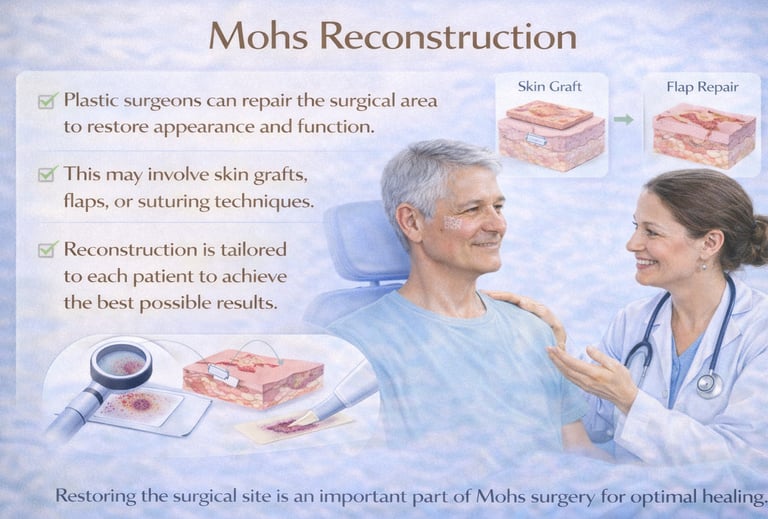
Mohs reconstruction focuses on restoring both function and appearance after skin cancer removal. This page explains why reconstruction may be needed after Mohs surgery, when it is performed, and how surgeons plan reconstruction to support healing and natural results.
Mohs reconstruction is the step that follows skin cancer removal and focuses on restoring the surgical site after Mohs surgery is complete. Once all cancer cells have been removed and clear margins are confirmed, attention turns to helping the area heal properly while preserving function and appearance.
Reconstruction is carefully planned based on the size, location, and depth of the surgical site. The goal is to support safe healing and achieve the best possible long-term outcome, while recognizing that each patient’s reconstruction needs are unique.
What Is Mohs Reconstruction?
Mohs reconstruction refers to the repair of the surgical site after skin cancer has been removed using Mohs surgery. This step is an important part of the overall treatment process and is tailored to each patient’s individual needs.
Purpose of Reconstruction After Cancer Removal
The primary purpose of reconstruction is to close and protect the area where the skin cancer was removed. Proper repair supports healing, reduces the risk of complications, and helps restore the skin’s natural barrier.
Reconstruction is planned only after clear margins are confirmed, ensuring that all cancer cells have been removed.
Restoring Function and Appearance
In addition to promoting healing, reconstruction aims to preserve or restore normal function, especially in areas such as the face, hands, or around the eyes and mouth. Careful technique helps protect movement, sensation, and important anatomical structures.
Appearance is also considered, with reconstruction designed to blend the repair as naturally as possible with surrounding skin while prioritizing safety and long-term skin health.
When Reconstruction Is Performed
Reconstruction is an integral part of the Mohs surgery process and is carefully timed to support safe and effective healing. The timing depends on medical findings and individual treatment needs.
Same-Day Reconstruction After Mohs Surgery
In most cases, reconstruction is performed on the same day as Mohs surgery once clear margins are confirmed. This allows the wound to be repaired promptly and healing to begin right away.
Same-day reconstruction also helps reduce the need for additional procedures or appointments.
Factors That Influence Reconstruction Timing
Several factors can influence when reconstruction takes place, including the size and location of the surgical site, the complexity of the repair, and individual health considerations.
In certain situations, delayed reconstruction may be recommended to allow swelling to decrease or to involve additional specialists. The timing is chosen based on what best supports healing and patient safety.
Reconstruction Options After Mohs Surgery
Several reconstruction options are available after Mohs surgery, and the approach is chosen based on the size, depth, and location of the surgical site. The goal is to support healing while preserving function and appearance.
Primary Closure
Primary closure involves bringing the edges of the wound together and closing them with stitches. This option is often used for smaller wounds or areas with enough surrounding skin to allow direct closure.
Primary closure typically follows a straightforward healing process.
Skin Flaps
Skin flaps use nearby skin that remains attached to its blood supply to cover the surgical site. This technique allows the surgeon to reposition tissue to achieve a natural contour and good color match.
Flaps are commonly used in areas with limited extra skin, such as the face.
Skin Grafts
Skin grafts involve taking a thin piece of skin from another area of the body and placing it over the wound. The graft relies on the underlying tissue to establish a new blood supply as it heals.
This option may be used when local tissue is not sufficient for closure.
Healing by Secondary Intention
Healing by secondary intention allows the wound to heal naturally without stitches or grafts. The area gradually fills in with new tissue over time.
This approach may be appropriate for certain locations and wound sizes and is selected when it can support safe healing and acceptable outcomes.
How the Best Reconstruction Method Is Chosen
Choosing the most appropriate reconstruction method after Mohs surgery involves careful medical judgment. The goal is to support healing, protect function, and achieve the best possible long-term result for each patient.
Size, Depth & Location of the Wound
The size and depth of the surgical wound play a major role in reconstruction planning. Larger or deeper wounds may require more advanced techniques to ensure proper closure and healing.
Location is also critical, especially in areas with complex anatomy such as the nose, eyelids, or lips, where precision is essential.
Skin Laxity & Patient Factors
The amount of available surrounding skin, known as skin laxity, affects which reconstruction options are feasible. Areas with more flexible skin may allow for simpler closures.
Patient-specific factors such as age, overall health, circulation, and prior surgeries are also considered to support safe healing and optimal recovery.
Who Performs Mohs Reconstruction
After skin cancer removal, reconstruction focuses on restoring both function and appearance while supporting proper healing. The approach to reconstruction depends on the size, depth, and location of the surgical site, as well as each patient’s individual needs. In many cases, reconstruction is completed on the same day as Mohs surgery.
Mohs Surgeon-Performed Reconstruction
Most Mohs reconstruction is performed by the Mohs surgeon who removed the skin cancer. Mohs surgeons receive specialized training in both skin cancer removal and surgical reconstruction.
Surgeon-performed reconstruction offers several advantages:
Immediate repair once clear margins are confirmed
Continuity of care from diagnosis through healing
Familiarity with the surgical site and surrounding anatomy
Focus on preserving function and minimizing visible scarring
Reconstruction techniques may range from simple closure with stitches to more advanced repairs using local skin flaps or grafts, depending on the wound.
When Additional Specialists Are Involved
In certain situations, additional specialists may be involved in reconstruction. This is typically considered when the surgical site is complex or involves areas requiring highly specialized repair.
Additional specialists may include:
Plastic surgeons
Oculoplastic surgeons (for areas around the eyes)
ENT or facial reconstructive surgeons
These specialists work closely with the Mohs surgeon to coordinate care. Referral to another specialist is based on medical judgment and the goal of achieving the best functional and aesthetic outcome, not on routine need.
Reconstruction planning is individualized, and patients are informed in advance whenever collaboration with another specialist is recommended.
Reconstruction in Different Areas of the Body
Reconstruction after Mohs surgery is tailored to the part of the body where the skin cancer was removed. Different areas heal differently and have unique functional and cosmetic considerations. The goal of reconstruction is always to support proper healing while preserving normal movement, sensation, and appearance whenever possible.
Facial Reconstruction Overview
The face is the most common area treated with Mohs surgery and often requires careful, detailed reconstruction. Facial skin contains important structures such as the eyes, nose, lips, and ears, which play a role in both appearance and daily function.
Facial reconstruction focuses on:
Preserving natural contours and symmetry
Protecting nearby structures such as eyelids, lips, and nasal passages
Placing incisions along natural skin lines when possible
Minimizing visible scarring over time
Depending on the location and size of the surgical site, reconstruction may involve layered closure, local skin flaps, or skin grafts. Many facial repairs are completed on the same day as Mohs surgery.
Non-Facial Reconstruction
Reconstruction on areas outside the face—such as the scalp, neck, arms, legs, hands, or trunk—follows the same principles of careful tissue repair and functional preservation. Healing expectations can vary depending on blood supply, skin thickness, and movement in the area.
Non-facial reconstruction may focus on:
Maintaining normal movement and flexibility
Supporting wound healing in areas under tension
Reducing the risk of delayed healing, especially on the lower legs
Providing durable repair for areas exposed to daily activity
Some non-facial wounds may be allowed to heal naturally, while others require stitches, flaps, or grafts. Your Mohs surgeon will recommend the most appropriate approach based on the location and size of the surgical site.
What to Expect After Reconstruction
Healing after Mohs reconstruction is a gradual process. While each patient’s experience is unique, understanding what is typical after surgery can help reduce anxiety and support proper recovery. Your surgical team will provide detailed instructions tailored to your procedure.
Immediate Post-Reconstruction Changes
Right after reconstruction, it is normal to notice visible changes at the surgical site. These changes are a natural response to surgery and usually improve with time.
Common immediate changes may include:
Swelling or puffiness around the treated area
Bruising or discoloration of the skin
Mild oozing or drainage
Tightness or numbness near the incision
A bandage or dressing is often placed to protect the area. Discomfort is typically mild and manageable with recommended pain relief methods.
Early Healing Expectations
During the first one to two weeks, the body begins repairing the surgical site. Stitches, if placed, are usually removed during this period unless absorbable sutures are used.
Early healing may involve:
Gradual reduction in swelling and bruising
Itching or tenderness as the skin heals
Temporary redness along incision lines
Formation of a healing scar that will continue to change over time
Following wound care instructions and attending scheduled follow-up visits are important steps in supporting proper healing and identifying any concerns early.
Cosmetic & Functional Outcomes
Reconstruction after Mohs surgery is designed to support both appearance and function. Careful planning and technique help ensure that healing progresses in a way that respects the natural structure of the skin and the role each area plays in daily life.
Preserving Natural Appearance
Whenever possible, reconstruction is performed in a way that blends with the surrounding skin. Mohs surgeons consider skin texture, color, thickness, and natural lines when planning repairs.
Cosmetic goals often include:
Aligning incisions with natural skin creases
Preserving facial symmetry and contours
Using nearby skin to achieve the best match
Allowing scars to mature and fade gradually over time
While scars are a normal part of healing, many become less noticeable as the skin recovers over several months.
Maintaining Function
In addition to appearance, maintaining normal function is a key priority during reconstruction. This is especially important in areas involved in movement, sensation, or essential activities.
Functional considerations may include:
Protecting eyelid movement and vision
Preserving nasal airflow and breathing
Maintaining lip movement for speech and eating
Supporting normal hand or joint motion
Reconstruction techniques are chosen to help ensure that the treated area heals in a way that allows it to continue functioning as naturally as possible.
Frequently Asked Questions About Mohs Reconstruction
Patients often have questions about reconstruction after Mohs surgery. The answers below address common concerns and are intended to provide general information. Your Mohs surgeon will discuss details specific to your procedure during your visit.
Common Reconstruction-Related Questions
Will reconstruction be done the same day as Mohs surgery?
In most cases, reconstruction is completed on the same day once all cancer has been removed. This allows the wound to be repaired promptly and supports proper healing.
Will I need a plastic surgeon for reconstruction?
Many reconstructions are performed by the Mohs surgeon. In certain complex cases, another specialist may be involved. This decision is based on medical considerations and the location of the surgical site.
How noticeable will the scar be?
All surgery results in some scarring. Mohs reconstruction is designed to minimize scarring by preserving healthy tissue and placing incisions thoughtfully. Scars often improve in appearance over time.
How long does reconstruction take?
The length of reconstruction varies depending on the size and complexity of the repair. Simple closures may take a short time, while more advanced repairs may take longer.
Will reconstruction affect how I look or move?
Reconstruction is planned to preserve both appearance and function. Temporary swelling or tightness is common early on, but most patients gradually return to normal as healing progresses.
What if I have concerns during healing?
Follow-up visits are an important part of care. Patients are encouraged to contact their surgical team if they notice unusual pain, bleeding, or changes at the surgical site.
Request a Mohs Consultation


Copyright © 2026 | Savannah Mohs Surgery | All Rights Reserved.
Privacy Policy | Terms and Conditions | Accessibility
Monday: 8:00am - 5:00pm
Tuesday: 8:00am - 5:00pm
Wednesday: 8:00am - 5:00pm
Thursday: 8:00am - 5:00pm
Friday: 8:00am - 5:00pm
Office Hours
Learn More
Reach Out
Resources
Address
Request Consultation
Call Now
(704) 858-6585
Savannah Mohs Surgery
Serving Savannah, GA and Surrounding areas.

